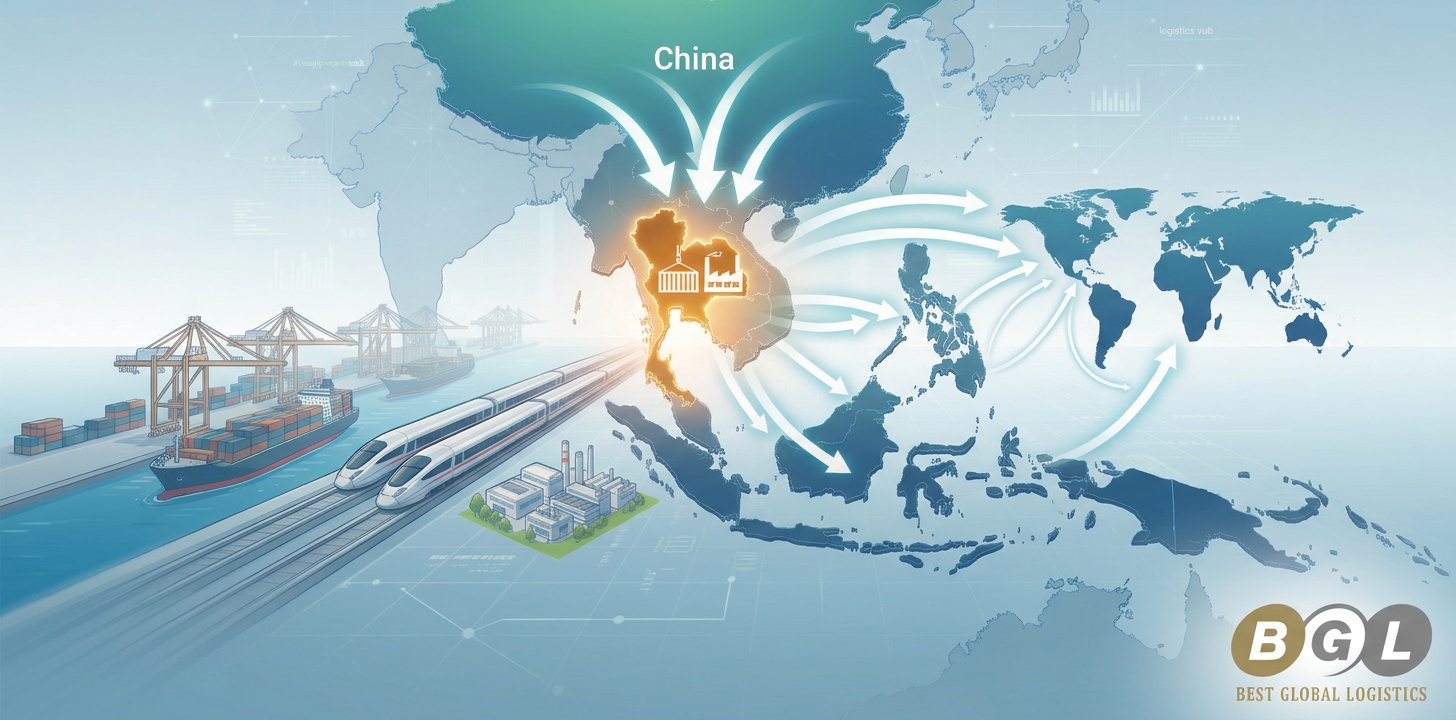
Global manufacturers are rethinking where they make and move goods. Geopolitical shifts and changing tariff rules have pushed many companies away from single-country sourcing. As a result, the China+1 strategy has become essential for building resilient supply chains.
Southeast Asia is the biggest winner of this shift. Specifically, Thailand stands out as a premier manufacturing and distribution hub for the entire ASEAN region. Here is how businesses can leverage Thailand’s infrastructure to strengthen their regional logistics.
Why Global Brands Are Choosing Thailand
Thailand offers more than just competitive production costs. It sits at the geographic heart of mainland Southeast Asia.Because of this location, companies can easily connect regional factories with global trade lanes.
Key Advantages for International Shippers
- Deep-Sea Port Capacity: Laem Chabang Port handles over 80% of Thailand’s maritime container throughput, linking ASEAN directly to major global shipping routes.
- Strong Industrial Ecosystem: The Eastern Economic Corridor (EEC) provides ready-made infrastructure for electronics,automotive, and high-tech manufacturing.
- Cross-Border Road and Rail Links: Modern highway and rail networks connect Thailand seamlessly to Laos,Cambodia, Malaysia, Vietnam, and southern China.
Managing Multi-Country Supply Chain Complexity
Moving production to a second country solves one problem, but it also creates new logistics challenges. Manufacturers often still import raw materials from China while assembling final goods in Thailand. Therefore, coordinating cross-border freight requires careful planning.
To keep goods moving smoothly, shippers should focus on three core practices:
- Adopt Multimodal Freight Solutions: Combine sea, air, and cross-border trucking to balance transit speed with freight budgets.
- Streamline Customs Documentation: Accurate Harmonized System (HS) codes and ASEAN Free Trade Area (AFTA) certificates prevent costly border delays.
- Use Regional Consolidation Hubs: Group smaller supplier shipments in Thailand before exporting full containers to Europe or North America.
Building a Resilient Regional Network
Diversifying your supply chain does not have to mean higher operational risk. With the right local partner, expanding into Thailand gives your business faster market access and stronger protection against global disruptions.
At Best Global Logistics, our team manages end-to-end freight forwarding, customs brokerage, and cross-border transport across Thailand and ASEAN. We help you turn supply chain diversification into a lasting competitive advantage.